
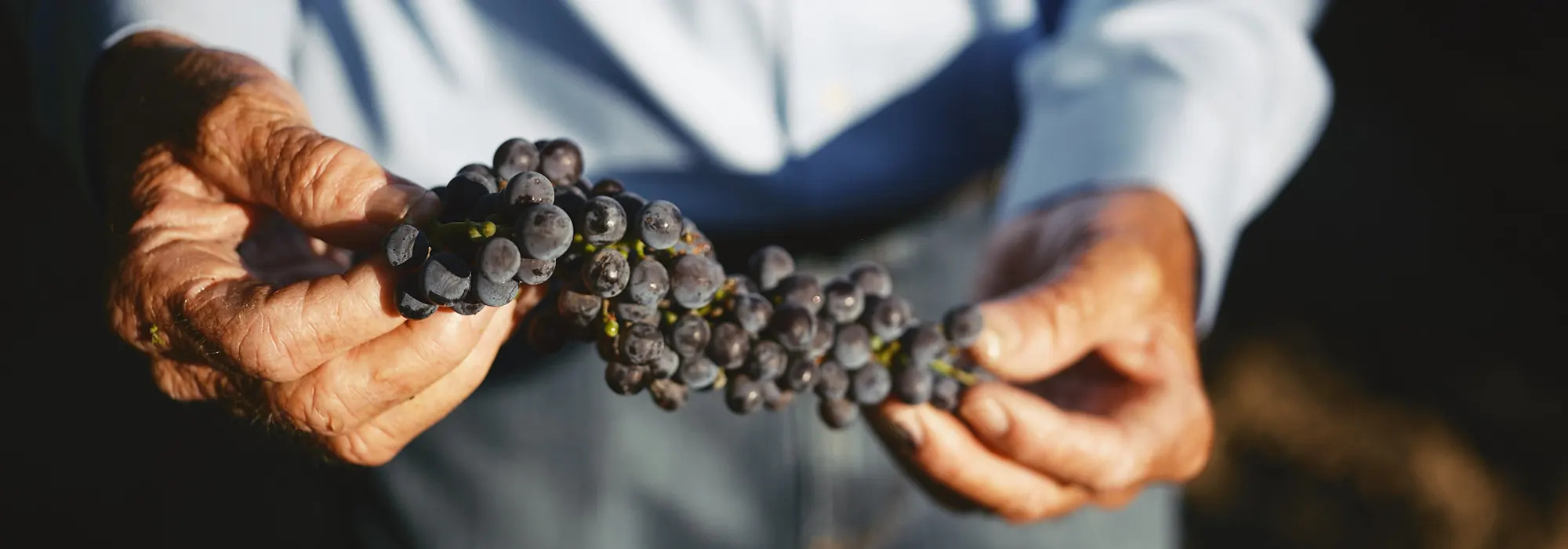
Temecula Valley’s 2026 Harvest Came in Like a Wrecking Ball
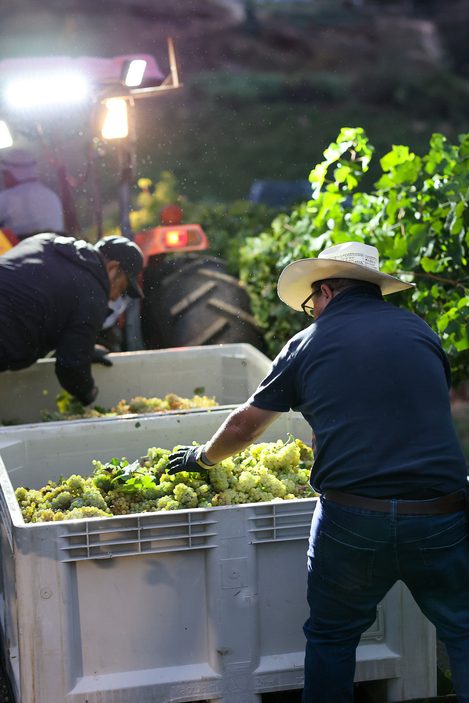
An unusually early, compressed harvest kept Temecula Valley winemakers on their toes, but promising fruit and standout varieties are giving them plenty to be excited about.
No two harvests are ever exactly alike, but in Temecula Valley, the 2026 vintage seemed determined to make its presence known. And known early.
Across the region, winemakers reported fruit arriving weeks ahead of the typical schedule, with warm winter conditions, an early budbreak, and a hot, weirdly humid growing season accelerating the calendar. What varied more noticeably was how individual vineyards and varieties responded to the season, particularly when it came to yields and which grapes emerged as standouts.
“2026 vintage was the most condensed harvest I’ve experienced in my 16 years of winemaking,” says Olivia Bue, winemaker at Robert Renzoni Vineyards. The winery’s estate Pinot Grigio — typically its first vineyard picked — came in four weeks earlier than it did in 2025, and 92% of the winery’s grapes arrived within a single month, compared with roughly two and a half months in most years.
“The vines didn’t get much of a chance to rest,” says Bue of the unusually warm, dry winter, which kicked off budbreak earlier than normal. “High humidity throughout summer increased mildew pressure on the grape clusters, while yields were lower than average. Together, these made for a demanding harvest in the cellar.”
At Wilson Creek, the fast pace came with similar challenges. Like Renzoni, the winery began picking nearly a month earlier than usual and wrapped harvest on September 25 — its earliest finish ever. But unlike some producers that saw smaller crops, Wilson Creek reported increased yields across a number of varieties.
“The 2026 vintage definitely kept us on our toes,” says the winemaking team, which includes winemaker Kristina Filippi and vineyard manager Greg Pennyroyal. As fruit moved through veraison, maturity was more uneven than usual, requiring careful vineyard management to help the vines catch up. In the end, though, the team was encouraged by what came off the vineyard.
“It was a demanding vintage, but the vineyard responded, and we’re excited about the quality and character we’re seeing in the wines,” the team says, crediting regenerative farming practices as one factor in the vineyard’s resilience this year.
Elsewhere, lower yields were a recurring theme. Callaway Vineyard & Winery winemaker Giovani Verdejo reported a smaller crop, as did Gershon Bachus. At Truffle Pig Winery, winemaker Mollie Haycock saw the same — but didn’t necessarily view that as bad news. “Yields are down, but that can be a good thing,” she says.
From a Challenging Season, Plenty to Watch
If the growing season demanded flexibility, what’s now taking shape in the cellar offers plenty of reason for excitement.
At Robert Renzoni Vineyards, Bue is particularly excited about the winery’s estate Sauvignon Blanc, Vermentino, and Syrah, each sourced from a different Temecula Valley vineyard.
“Despite the challenging weather conditions — a warm, dry winter, hot-humid summer — all three varieties showed great resilience and produced excellent quality fruit,” she says.
For Bue, that unpredictability is winemaking’s allure, and part of what contributes to the distinctiveness of a given vintage. “Winemaking is never a recipe,” she says. “We constantly adjust our practices in the vineyard and cellar, responding to what each vintage gives us and staying on our toes. Agriculture can be unpredictable. Every season brings new conditions and challenges, but that’s what makes each vintage unique.”
At Wilson Creek, one of the most intriguing wines to watch from 2026 may be Tannat, the inky, thick-skinned grape that originated in southwest France but is now the most widely planted grape in Uruguay. This was the winery’s first full-production year with a new clone, ENTAV-INRA 171.1 on 1103P rootstock.
“Tannat is known for its deep color, structure, and powerful tannins, but this particular clone gives us that same intensity with tannins that can be a little softer and more approachable,” says the Wilson Creek team. “The fruit has a lot of potential for a wine that is dense and complex, but still very enjoyable to drink.”
Cinsault and Viognier are also showing early promise. “That’s one of the most fun parts of harvest — watching these wines begin to take shape and knowing there are still plenty of surprises ahead,” the team says. “We’re looking forward to sharing them when they’re ready.”
At Callaway, Verdejo singled out Petite Sirah for its “deep, dark color with amazing flavors.” The winery also harvested newly grafted Cabernet Franc and Merlot this year for limited-production wines intended for its OPR club members.
At Truffle Pig, Haycock has her eye on both familiar favorites and a few new projects. “I’m really excited about the Chardonnay that we are producing this year, as well as some of the Rhône varieties,” she says. “We have experimented with a couple more varietal dry rosés that we will be releasing toward the end of the year.”
Gershon Bachus Vintners is experimenting, too, producing its first rosé from the 2026 vintage. Owner Christina Falik says she’s particularly optimistic about what’s coming from the estate. “We believe our estate wines will be very high in quality when they are released in five years.” Of the harvest overall, she adds simply, “The quality was really nice.”
Harvest Ends. The Next Chapter Begins.
The last grapes may be in, but across Temecula Valley, there’s plenty happening beyond the 2026 vintage itself.
At Robert Renzoni Vineyards, October brings the debut of The Cellar, a new underground space beneath the tasting room inspired by the wine cellars of Italy.
“The Cellar is an intimate setting designed for guests to enjoy exceptional Riserva wines, thoughtful food pairings and warm Italian hospitality,” says Bue.
Callaway, meanwhile, is preparing a late-fall release that takes the winery in a decidedly different direction: a 2024 bourbon barrel-aged Zinfandel, aged in a combination of 50% new oak and 50% unwashed bourbon barrels.
At Wilson Creek, the next chapter extends beyond what’s in the bottle. The winery plans to continue building experiences around the regenerative agriculture work happening in its vineyards.
“Regenerative agriculture has become an important part of our story, and we’re looking for more ways to bring guests into the vineyard and share what we’ve learned about soil health, biodiversity, and farming for the future,” says the Wilson Creek team.
“Most of all, we want to keep giving people new reasons to come together at Wilson Creek,” the team adds. “Whether it’s a new wine, a dinner, live music, a vineyard experience, or simply an afternoon with family and friends, we’re always asking ourselves what we can do next to make a visit feel special.”
Truffle Pig is also looking beyond the cellar as the year winds down. Along with several new wine releases, Domenico’s Italian Chophouse, the winery’s on-site restaurant, will roll out fresh seasonal selections, while the winery’s Pig Pen lounge continues its late-night cocktail hours Thursday through Sunday. Beginning October 11, the lounge patio will also host cigar nights every other Sunday.
At Gershon Bachus, recent releases are exploring a lighter side of red wine. The winery’s Nouveaux series includes Paeon, its first natural Cabernet Sauvignon, along with The Horse, a Petite Sirah aged for five months in barrel. Both are part of what Falik describes as a series of “light and bright” reds designed to be enjoyed chilled.
For Temecula Valley, the unusually early 2026 harvest may already be over. But between the wines now taking shape and a crop of new releases, experiments and tasting experiences on the horizon, its story is really just getting started.
